
Dual-Domain Systems™
Synergy Premix — BioGala™ + BioQin™
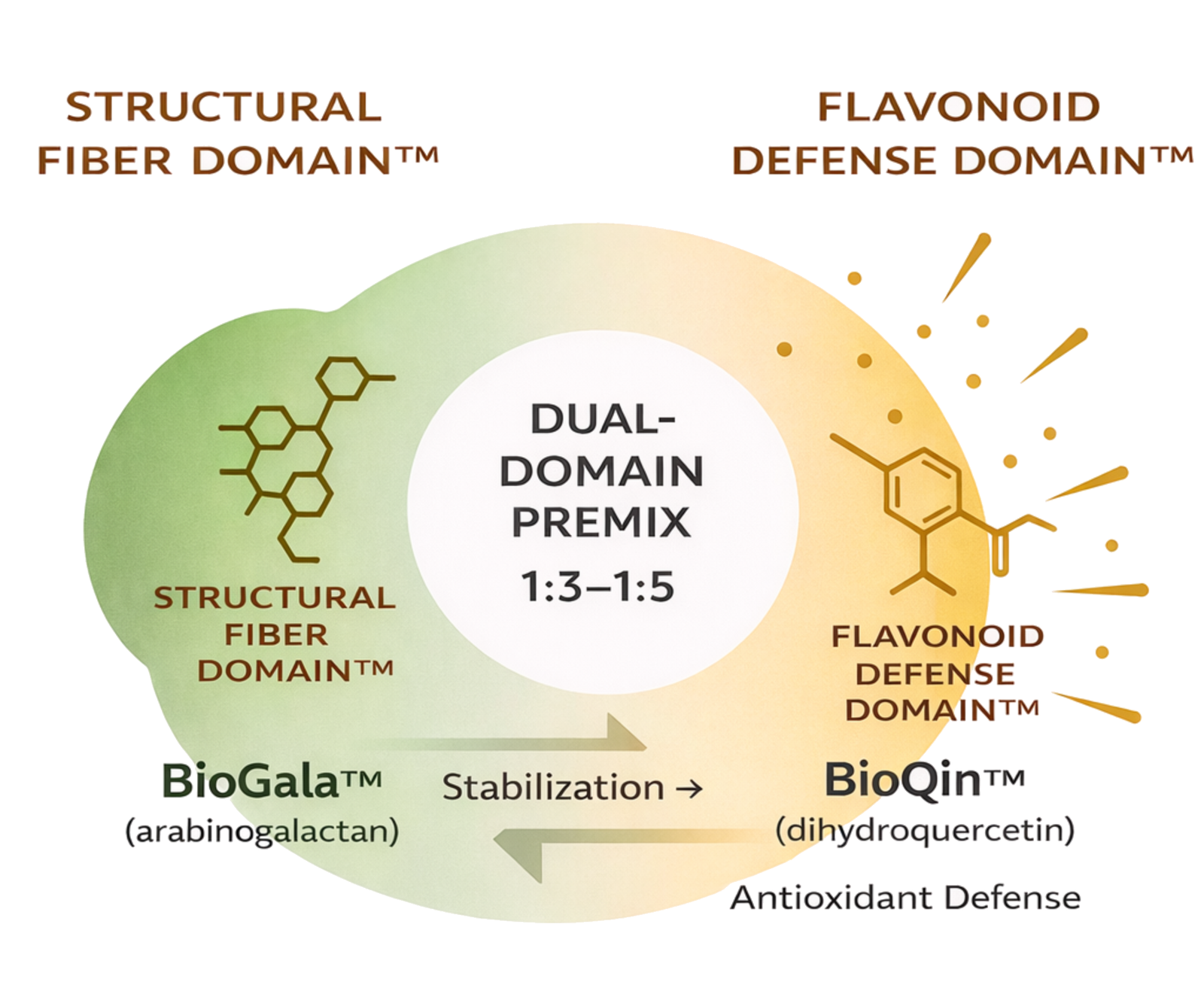
The Dual-Domain Synergy Premix combines BioGala™ arabinogalactan (Structural Fiber Domain™) and BioQin™ dihydroquercetin (Flavonoid Defense Domain™) into a single, pre-balanced ingredient system. Available in 1:3 and 1:5 ratios (DHQ:AG by weight), it delivers structural fiber and high-efficacy antioxidant defense together—so formulators can build dual-mechanism products with one clean, Dahurian larch–derived premix.
Biomimetic design: The AG fiber network is used as a supramolecular carrier matrix to physically stabilize and help disperse DHQ, while the DHQ:AG ratios are selected to echo the tree’s own fiber–flavonoid balance.
Overview
Structural Fiber × Flavonoid Defense from Dahurian larch. The Synergy Premix is a pre-formulated system that pairs BioGala™ (arabinogalactan) and BioQin™ (dihydroquercetin / taxifolin) in analytically defined ratios so you can formulate dual-domain architectures with a single ingredient input.
Concept & Design
In the tree, the Structural Fiber Domain™ (arabinogalactan) and Flavonoid Defense Domain™ (dihydroquercetin) operate as a coordinated survival strategy:
- Fiber maintains hydration, structure, and internal stability.
- Flavonoid provides redox defense and protection under environmental stress.
The Synergy Premix translates this natural pairing into two formulation-ready systems: Synergy Premix 1:3 and Synergy Premix 1:5—built on tree-native architecture and biomimetic design intent:
- Tree-native architecture: arabinogalactan stabilizes hydration/structure; DHQ provides redox defense under stress.
- Supramolecular AG–DHQ complex (design intent): AG serves as a biomimetic carrier scaffold for DHQ to support dispersion and even distribution.
- Biomimetic DHQ:AG ratios: 1:3 and 1:5 are chosen to echo the larch’s fiber–flavonoid balance—so the system isn’t arbitrary.
Indicative Composition and Product Characteristics
Both premixes are designed to be analytically defined and manufacturing-friendly. Each batch is supported by DHQ assay (HPLC), AG content verification, moisture/ash controls, and microbiology screening.
| Parameter | Synergy Premix 1:3 (DHQ:AG) | Synergy Premix 1:5 (DHQ:AG) |
|---|---|---|
| Design bias | Higher flavonoid density; antioxidant-forward | Higher fiber loading; prebiotic / structural-forward |
| Dihydroquercetin (DHQ) | ~ 25% | ~ 17% |
| Arabinogalactan (AG) | ~ 75% | ~ 83% |
| Solubility / dispersion | High, fiber-driven solubility with good dispersion | Very high solubility with a clear-soluble fiber base |
| Appearance | Light cream to pale yellow powder | Light cream powder |
| Flow / handling | Free-flowing, AG-driven handling profile | Free-flowing, AG-dominant handling profile |
Note: Percentages shown are nominal target values for communication purposes and should be understood as approximate rather than exact compositional values. Final specifications and acceptable ranges will be defined in the applicable technical documents and COA.
Functional Profile — What the Synergy Premix Delivers
1) Structural Fiber Domain™ — BioGala™ Component
- Prebiotic & microbiome support: fermentation → SCFA production.
- Gentle tolerance profile: enables higher functional fiber loads with fewer GI complaints.
- High-load, clear solubility: suitable for beverages and liquids without viscosity.
- Moisture management: supports texture and water retention in solids.
2) Flavonoid Defense Domain™ — BioQin™ Component
- High-efficacy antioxidant activity: BioQin™ DHQ (hydrophilic ORAC ≈ 32,700 µmol TE/g, DHQ-driven).
- Redox buffering: supports oxidative resilience in biological and formulation environments.
- Vascular / microcirculation relevance (mechanistic): fits performance and recovery concepts where oxidative stress is relevant.
- Gut–liver axis partner: complements fiber-driven SCFA pathways with redox support.
System logic: fiber provides architecture + dispersion + tolerance; DHQ provides defense + oxidative buffering. Together they support a coherent “dual-domain” product narrative.
Why Use the Synergy Premix Instead of Sourcing Separately?
- Pre-balanced domain ratios: meaningful DHQ signal + functional AG dose in one system.
- Simplified formulation math: one ingredient input; easy dose translation.
- Enhanced distribution: AG matrix helps distribute DHQ across the blend.
- Streamlined story: one origin, one sustainability narrative, one platform framing.
Choosing Between 1:3 and 1:5
Synergy Premix 1:3 (Higher DHQ Emphasis)
- antioxidant-forward nutraceuticals
- redox messaging (ORAC, oxidative stress, performance) is central
Synergy Premix 1:5 (Higher Fiber Emphasis)
- microbiome / prebiotic / digestive-environment products
- fiber dose, tolerance, and techno-functionality are primary
Both can be further combined with standalone BioGala™ or BioQin™ if formulators need to bias the system further in either direction.
Origin & Sustainability
Like BioGala™ and BioQin™, the Synergy Premix is derived from winter-harvested Dahurian larch stumps — a renewable forestry by-product. No trees are cut specifically for extraction.
Technical & Commercial Support
- Technical dossiers for BioGala™, BioQin™, and Synergy Premix formats
- Guidance on dosing, positioning, and labeling for dual-domain formulas
- Application support across nutraceutical, functional food, and animal nutrition